Our Vision
Our lab aims to understand how cells respond to internal and external signals to change state and fate. Using adult neural stem cells (NSCs) as a model system, we challenge current dogmas regarding cell identity and fate transitions, positioning heterogeneity as a crucial factor in these processes. We continuously adopt and develop novel methodologies and analytical tools to characterize physiological cellular states and resolve cellular heterogeneity. Ultimately, we seek to identify specific signals to promote stem cell-based tissue regeneration and to slow down ageing.
Our Research
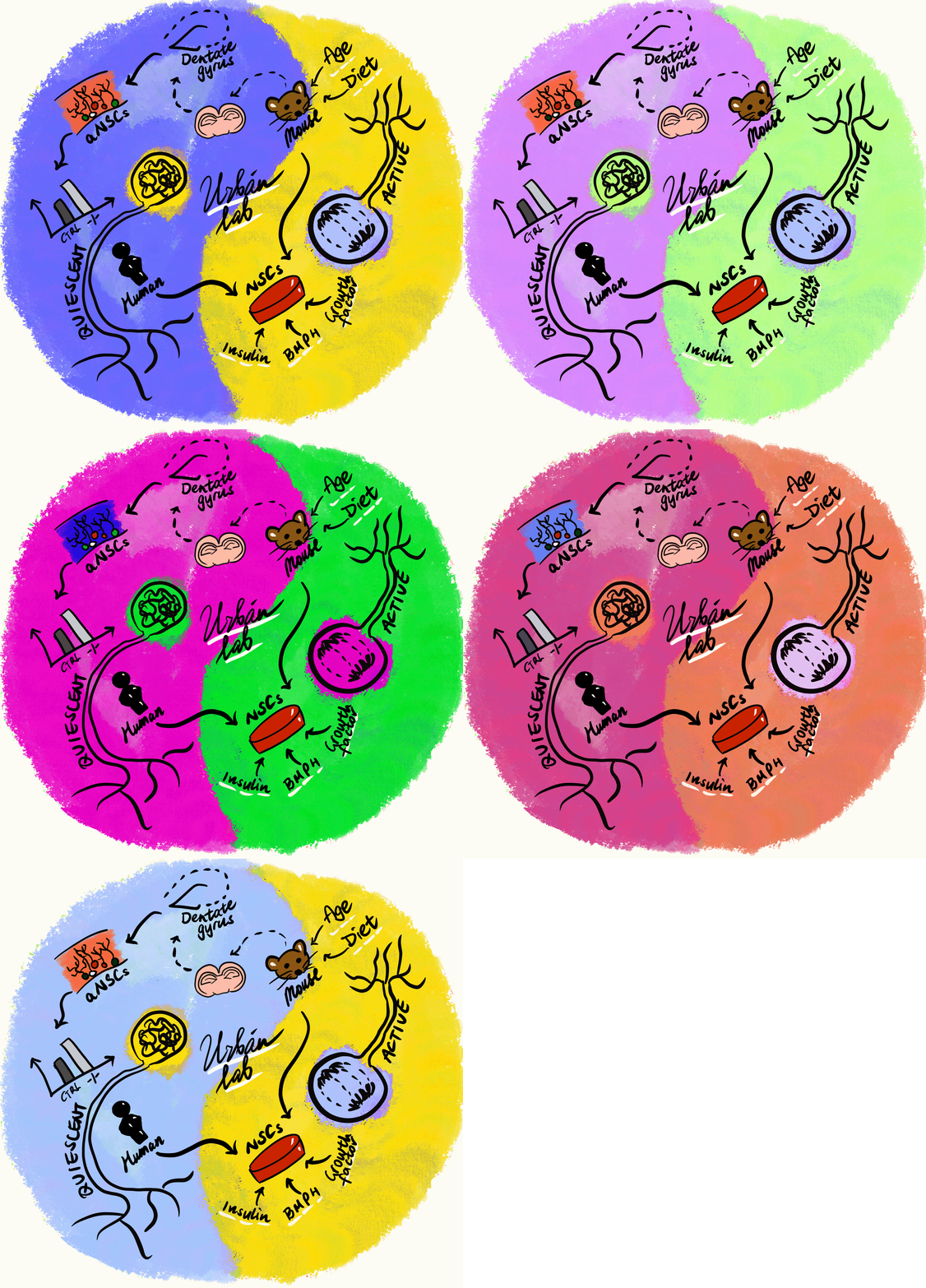
During embryonic and postnatal stages NSCs enter quiescence, a non-proliferative yet reversible state. Quiescent NSCs form a stem cell reserve that gets activated throughout life to generate new neurons. Maintaining this reserve is essential, as NSCs in the adult neurogenic niches have a limited self-renewal capacity; thus, repeated activation results in stem cell pool exhaustion.
Our lab studies how NSCs transition between quiescent and active states, with a focus on the mechanisms that sustain quiescence.
Our contributions to the field can be summarized in three main concepts:
1. Quiescence is heterogeneous:
Quiescent neural stem cells were traditionally viewed as a uniform, dormant population. We showed that not all quiescent NSCs behave equally: those that recently activated are much more likely to re-activate (Urbán et al., 2016). We also observed that age regulates NSC transitions between different states (Harris et al., 2021) and that NSC respond differently to signals depending on their state (Austin et al., 2021). In addition, other labs identified further heterogeneity among NSC, both in quiescence depth and fate potential.
Taking it all together, we propose NSC heterogeneity as a crucial factor for the function and regulation of quiescent NSCs. Defining and understanding NSC heterogeneity is one of our current research interests.
2. Quiescence is an active state:
Quiescent NSCs are not passive elements of the niche, they have an enhanced capacity to listen and process niche signals, adapting their responses to the needs of the tissue.
For instance, we showed that they constantly express and rapidly degrade the pro-activation transcription factor ASCL1, which functions as a rheostat integrating multiple niche signals (Andersen et al., 2014). Subsequent work from the lab showed the quick responsiveness of NSCs to environmental signals such as BMP (Blomfield et al., 2019) and WNT (Austin et al., 2021), as well as their unexpected resilience to systemic changes such as intermittent fasting (Gabarró-Solanas et al., 2023).
The lab maintains a strong research focus on signal integration and the bidirectional crosstalk between NSCs and their surrounding niche.
3. Non-transcriptional mechanisms regulate quiescence:
We have demonstrated that NSC transitions between active and quiescent states are driven by non-transcriptional events. We identified HUWE1, an E3-ubiquitin ligase, as a crucial regulator of NSC activation through the control of ASCL1 levels (Urbán et al., 2016). In addition, we showed that niche signals like BMP4 increase ID proteins in NSCs, which in turn promote the proteasomal degradation of ASCL1 via sequestration of its needed heterodimerization partners, the E-proteins (Blomfield et al., 2019).
Our current efforts focus on developing single-cell proteomics pipelines to measure and identify protein-level changes that control NSC states. Parallel to this, we are deepening our understanding on HUWE1 activity, as it is a pivotal regulator of NSC quiescence. Furthermore, we are exploring other non-transcriptional mechanisms of control, such as differential subcellular localization of proteostasis and signaling components between cellular states.
Youtube Video: Scientist Snapshot of Noelia Urban, IMBA, Vienna BioCenter
“What I find most exciting about science is this moment when you put the pieces together and have this WOW of I finally understand something.”
About Us
Selected Publications
NEWS